Showing posts with label future. Show all posts

Tuesday, November 25, 2014

The Future of Cars #4

Magnifying Solar Power

Electric cars, hydrogen cars, and now solar cars? All for the environmentally friendly people, this is one more step away from fossil fuels. The goal is the endless supply of renewable energy, like sunlight. Now, thanks to a late invention, a giant magnifying glass could be powering your future car. 

Developers from Georgia Tech have joined Ford Motors to build a concept hybrid car that would park under a special concentrator that magnifies the sun's rays to recharge the C-Max Solar Energi vehicle. In one day of charging you can achieve 620 miles worth of driving. 

The C-Max Concept has 5 foot wide solar panels on the car's roof with a specialized design to capture and intensify the sun's rays. The canopy's magnifier will track the sun's brightest rays throughout the day, getting the most energy possible. Although it doesn't look like it's hitting the markets anytime soon, with enough support from fans, this can be a soon enough possibility.


The C-Max Concept...

The Future of Cars #3

Hydrogen Power

Finally, a alternate source of power for vehicles is being introduced by Toyota, Honda, and Hyundai next year. The auto manufactures have been evaluating these models for more than a decade, and more car companies such as Mercedes and GM are working on models as well. 

One of the benefits of Hydrogen fuel cells is that they are capable of long range driving unlike the Model S from Tesla (an all electric power house). These vehicles can reach distances of 400 miles, recharge in a matter of minutes. and are of course environmentally friendly. 

However, hydrogen fuel cells have other challenges, one being the lack of refilling stations in the U.S. Another challenge is the lack of performance in colder climates and the batteries are simply massive for the car compared to the Model S battery. Manufactures are working on overcoming these problems though, Honda and Toyota claim that they have already made successful advances at these obstacles with the help of constantly improving technology. 

The Future of Cars #2

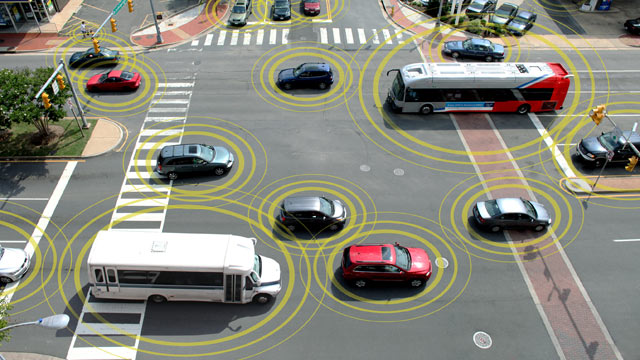
A network of talking vehicles. 

Now days, electronics talking to each other isn't an uncommon occurrence. The bluetooth speaker telling your smartphone it's running out of battery or your car warming itself up with a push of a button on your smartphone app. It's not much longer until your car will be communicating with all the other cars on the highway on your way to work and home. 

This means that cars will be able to share traffic conditions as well as the weather and road blocks. The speed and direction of your car will also be shared with other vehicles on the road, warning others about potential hazards. This is called vehicle-to-vehicle communication, also known as, V2V. 

Prototypes have already been tested on about 3,000 cars and trucks. These devices send a short range safety signal to other vehicles to find potential accidents. The cars will send a "beep" to other cars when they detect danger, such as when another car enters a intersection, a pedestrian walks by, or another driver is driving way to fast. 

The research team behind this believes that this could get rid of almost 80% of all car wrecks on the road today. It's only a matter of time before this V2V technology is equipped on all vehicles.

Friday, November 21, 2014

3-D Printing Innovation Making better Vehicles?

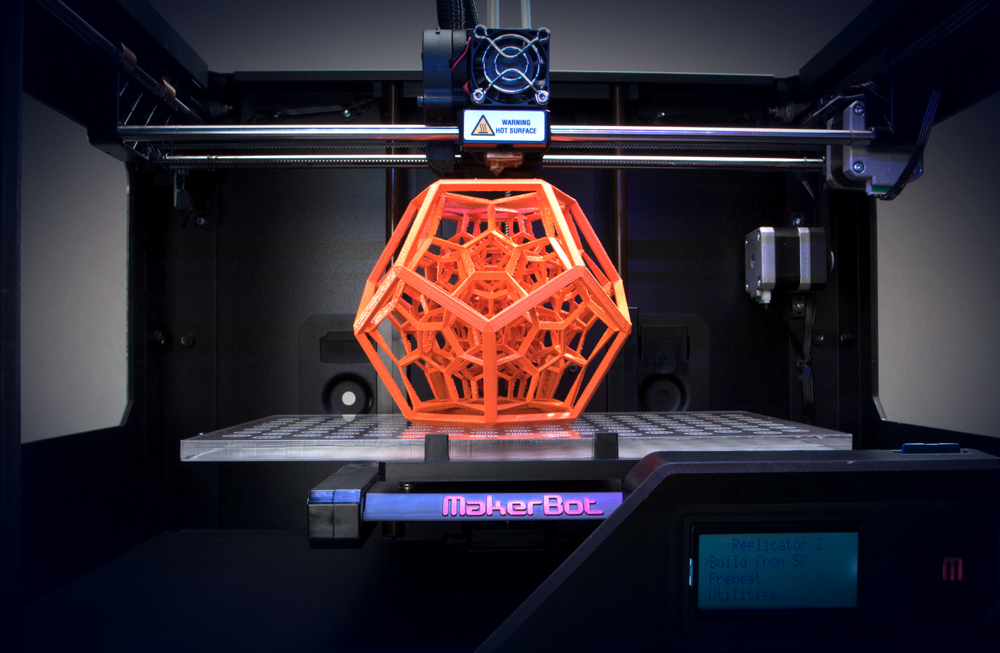
The technology for 3-D printing only gets better, and with the latest news from Frontier Additive Manufacturing it could make vehicles more advanced and efficient. 

Eric Lynch, president and co-founder of Frontier Additive Manufacturing commented, "We are commercializing a multiple-laser method to create products at the micro-structural level that exceeds current 3-D printing capabilities' structural integrity with the ability to adjust material properties in the original location of the part. These are replacement or new products that could easily replace new or worn parts in manufacturing machinery, automotive or aerospace engines. The technology is developing quickly, and we are already successfully engaged with the medical implant industry. We also are in discussions with the automotive, aerospace and oil and gas industries."


The older 3-D printing methods could only hold about 60-70% of the original parts, which could obviously create problems down the road. Although Eric Lynch and his company are finding solutions to go above and beyond what was previously thought possible. The company's work is also decreasing the time needed to make such products significantly. Lynch claims that they'll be able to manufacture parts in an all in one center, cutting down on certain processes that were previously needed and focus the work on a single part. 


This has the potential to help the auto industry produce stronger, lighter, more advanced parts faster than ever before. 

Wednesday, November 19, 2014

Future Auto Ideas

#1 Air Propulsion
In the LA Auto Show Design Challenge, Cadillac advances their EV and efficiency efforts with the idea of air propulsion. It has an incredible range of 1,000 miles on compressed air before refueling. To bad it's not expected to be here anytime before 2030. 


#2 In-wheel Magnetic Drive System
It's a mouth full, but i'll cut down the weight and moving parts that are needed making the car that much better. The wheels have hub-less motors that are exclusively patented by Nissan technology. This kind of tech could be out in another 15 years. 

#3 (Finally) Oxygen Emissions 
Future Vehicle Tech
One extremely awesome future vehicle tech model is the Mercedes Biome. This car of the future doesn't produce those hateful emissions. Instead, it spews back oxygen into our air. It was a compelling concept at the LA Auto Show. Although, it's not expected to be an option until 2050.  

Google gets Android into Automotive Dashboards

According to the latest news at Google, they say that they are now taking the Android operating system to the cars dashboard (those with touchscreens). Google developers are working on  "Android Auto" software that will work  regardless of the vehicles specific hardware specs. 

Android Auto

Because this is Android, third-party developers will have a chance to make apps or assist with software updates along the side of Android Auto. Although Google isn't alone on this automotive advancement, Apple is also racing down the same road for their own preferred auto enhancements.  

Android users can "simply connect their Android handheld to a compatible vehicle and begin utilizing a car-optimized Android experience that works with the car's head unit display, steering wheel buttons," said Daniel Holle. 

Wednesday, November 12, 2014

Introducing the Unstoppable Tire


Michelin's new tires, "Tweel" has made several new patterns for its unstoppable and airless wheels. 

Michelin has added a hard surface tread pattern and an all-terrain tread pattern to its Tweel

The one on the left with the smooth tread has a 100% surface contact ratio that provides maximum tread life and transfer of power for the pavement. On the right, the more rugged all terrain tackling design is set up for taking on anything off the pavement. The pattern on the all terrain tire can wick away mud by itself and can take on much heavier loads than their air filled brothers.  


Michelin says that these new Tweels can last up to three times longer than standard tires. Basically, anyone that owns one of these power tires will notice greater performance, stability, and durability. 

Monday, November 10, 2014

The "Egg Car"

Hyundai has developed a new concept for the car of the future, putting a new spin on a mobility scooter - the 'E4U' an egg-shaped, open-topped single person 'scooter'

Hyundai created a weird, egg shaped, concept car for people to roll around in. The "egg" (a.k.a. the E4U) fits one driver and will scoot them along at a causal walking speed.


Doing away with the traditional two-wheel design, the Hyundai concept vehicle instead uses a 'rotating semispherical part'


What makes this car especially unique is that it uses a rotating semi-spherical piece instead of a wheel to move around. This looks much like the lower half of a sphere that's constantly spinning while on the move.


It works like the lower half of a ball, which is constantly spinning and used for propulsion instead of wheels


The driver stands on a platform that also allows the diver to steer by tilting the frame to where they want to go. There are two "legs" on the back of the device that helps with stability from side to side. Since you can never be to safe, rumor has it that there's a matching helmet along with the vehicle.

Thursday, October 16, 2014

Autopilot Features & Capability Tesla Motors Model S D

With all the hype of Tesla Motors latest model "the D", is the autopilot feature really capable of handling itself the way it's promoted? I believe the answer is yes... and no. 

At the moment, it is one of the most advanced cars available with some of the greatest safety features ever built in. The autopilot used a system of new radars, GPS, and camera sensors to run on the road. These features are unmistakably impressive, but the reality of it is that it's more of a turbo charged driver assist feature as of now. Musk has reveled future plans though for the vehicle that will improve it's autopilot functions as time goes on. 

Although, when the vehicle is described by Musk as, "this car is nuts. It's like taking off from a carrier deck. It's just bananas. It's like having your own personal roller coaster", I would want to feel the power transferring into my hands on the steering wheel, non-stop. 

Thursday, September 25, 2014

Augmented Reality Windshields

Mercedes is creating a virtual reality for the daily driver. An augmented reality dashboard demonstrated at CES in 2012, so the chances of this being made a "reality" in the near future is inescapable. Sometimes, a video can explain more than words ever can.

Whether this will create more or less distractions is arguable. Some say that this is an amazing safety feature because the driver never has to take their eyes truly off the road. On the other side, with so many notifications, updates, or phone calls flying in front of the drivers eyes, does this truly help the driver? Especially when you consider that the driver could leave the phone in their purse/pocket.

The game changer may be self-driving vehicles. Google has already made several prototypes of vehicles that drive by themselves with the help of radar detection, satellite, lasers, GPS, and multiple cameras. With the latest self-driving cars built with augmented reality windshields, the safety aspect might be considered "perfected".


Friday, September 19, 2014

Self-Healing Car Windows

Vehicles are undergoing through a huge amount of stress these to deliver the best possible experience for the drivers. A common problem for daily drivers are small cracks in the windshield that come about, eventually. 

To combat this problem, self-healing (or self-repairing) substances are becoming more and more popular. While you shouldn't expect a completely shattered windshield from a car wreck to magically repair itself, smaller breaks (even bullet holes) could repair itself. Similar experiments have been used with smaller glass screens like cell phones and even plastics. Autoglass is fully charged with improving and making the best possible glass for vehicles. 

For a quick example,  fast forward to 50 seconds and watch the magic happen. 


This is beautiful for not only aesthetic reasons, but it could be a cost effective solution as well. No longer would a driver have to replace the entire windshield from multiple cracks or chips. Neither would they have to worry about the crack growing across the windshield, impairing the drivers view. 

With technology like this thanks to Autoglass, the future advancements of augmented dashboards on vehicles become that much more practical and safe.