Showing posts with label vehicles. Show all posts

Tuesday, November 25, 2014

The Future of Cars #4

Magnifying Solar Power

Electric cars, hydrogen cars, and now solar cars? All for the environmentally friendly people, this is one more step away from fossil fuels. The goal is the endless supply of renewable energy, like sunlight. Now, thanks to a late invention, a giant magnifying glass could be powering your future car. 

Developers from Georgia Tech have joined Ford Motors to build a concept hybrid car that would park under a special concentrator that magnifies the sun's rays to recharge the C-Max Solar Energi vehicle. In one day of charging you can achieve 620 miles worth of driving. 

The C-Max Concept has 5 foot wide solar panels on the car's roof with a specialized design to capture and intensify the sun's rays. The canopy's magnifier will track the sun's brightest rays throughout the day, getting the most energy possible. Although it doesn't look like it's hitting the markets anytime soon, with enough support from fans, this can be a soon enough possibility.


The C-Max Concept...

The Future of Cars #2

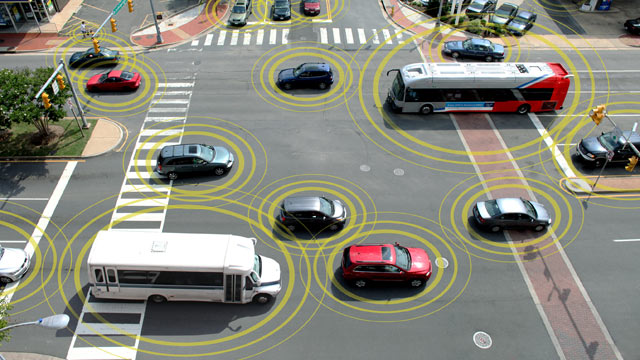
A network of talking vehicles. 

Now days, electronics talking to each other isn't an uncommon occurrence. The bluetooth speaker telling your smartphone it's running out of battery or your car warming itself up with a push of a button on your smartphone app. It's not much longer until your car will be communicating with all the other cars on the highway on your way to work and home. 

This means that cars will be able to share traffic conditions as well as the weather and road blocks. The speed and direction of your car will also be shared with other vehicles on the road, warning others about potential hazards. This is called vehicle-to-vehicle communication, also known as, V2V. 

Prototypes have already been tested on about 3,000 cars and trucks. These devices send a short range safety signal to other vehicles to find potential accidents. The cars will send a "beep" to other cars when they detect danger, such as when another car enters a intersection, a pedestrian walks by, or another driver is driving way to fast. 

The research team behind this believes that this could get rid of almost 80% of all car wrecks on the road today. It's only a matter of time before this V2V technology is equipped on all vehicles.

The Future of Cars #1

Cars that collect and remember data about you. This might sound scary to some of you but in reality, this is something that could really help throughout the day to day activities. All of these new cars carry on-board computers that handle everything that the car does, from the stereo to the brakes. Because of this, computers can alos analyze the trends and inefficiencies of those driving behind the wheel. It wont be much longer before the car knows exactly where you want to go as soon as you step inside. 

Mercedes-Benz is the leader in this program and is developing a system that learns about the driver over time. It will learn your weekly schedule, food preferences, and perhaps even what mood you're in. Not only that, but it'll link up to the GPS and receive satellite data to help find the fastest route to where you go every minute. 

Keep this in mind next time you go car hunting a couple years in the future. The car will be getting to know you, not the other way around. 

Friday, November 21, 2014

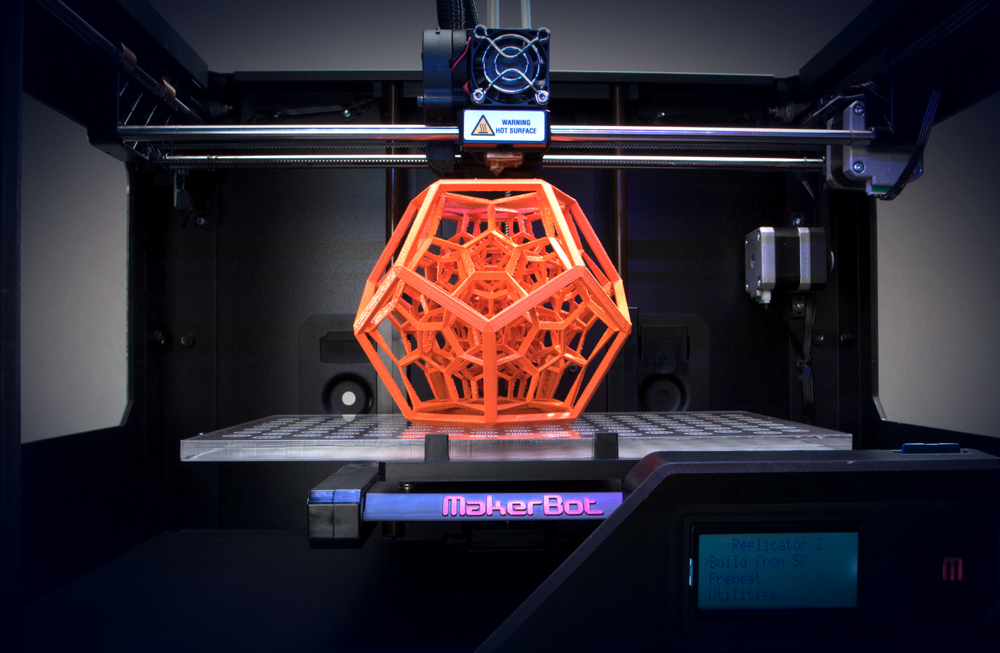
3-D Printing Innovation Making better Vehicles?

The technology for 3-D printing only gets better, and with the latest news from Frontier Additive Manufacturing it could make vehicles more advanced and efficient. 

Eric Lynch, president and co-founder of Frontier Additive Manufacturing commented, "We are commercializing a multiple-laser method to create products at the micro-structural level that exceeds current 3-D printing capabilities' structural integrity with the ability to adjust material properties in the original location of the part. These are replacement or new products that could easily replace new or worn parts in manufacturing machinery, automotive or aerospace engines. The technology is developing quickly, and we are already successfully engaged with the medical implant industry. We also are in discussions with the automotive, aerospace and oil and gas industries."


The older 3-D printing methods could only hold about 60-70% of the original parts, which could obviously create problems down the road. Although Eric Lynch and his company are finding solutions to go above and beyond what was previously thought possible. The company's work is also decreasing the time needed to make such products significantly. Lynch claims that they'll be able to manufacture parts in an all in one center, cutting down on certain processes that were previously needed and focus the work on a single part. 


This has the potential to help the auto industry produce stronger, lighter, more advanced parts faster than ever before. 

Monday, October 13, 2014

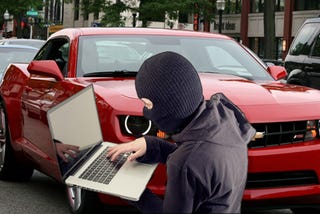
Possibility of Hacking the Modern Car?

On-star services are already capable of bring your vehicle to a halt if needed, but what about the rest of the population?

Technology in cars gets more advanced every year and usually for safety reasons or gadget upgrades which is great. Lane assist, brake assist, parking assist, rear view cameras, pedestrian sensors, and numerous other features are all possible thanks to those internal computers. Although these features are great, all these could be rendered useless and extremely dangerous if hackers found a way around the security.

In the realm of happy thoughts, there has been no evidence that anyone has hacked into auto computer systems. However, this doesn't make it an impossibility. There wasn't a virus for computers the first day the PC was released, it took a while. Fast forward to today and viruses are rampant and constantly attacking are home computers.

Two computer science professors at the University of Washington, Savage and Yoshi Kohno, were able to bypass network security within the car and were able to ignore a drivers input if they wanted (including the brakes and stopping the engine). While this is a good reason to worry, it also took this team about two years to accomplish this and even stated that the chances of anything similar happening to the average person is extremely low.